
GitHub私有仓库协作者与私有fork权限规则
GitHub私有仓库的访问控制,核心在于“谁被允许进入、能做什么”。根据GitHub官方文档,仓库所有者可以通过邀请他人成为协作者来开展协作,协作者获得的是对代码的贡献权限,以及对议题和拉取请求的管理权限。这意味着私有仓库并非只有所有者一人可见,而是可以按需引入外部或内部成员参与具体工作。理解这一机制,有助于团队在代码保密与协作效率之间找到平衡点。
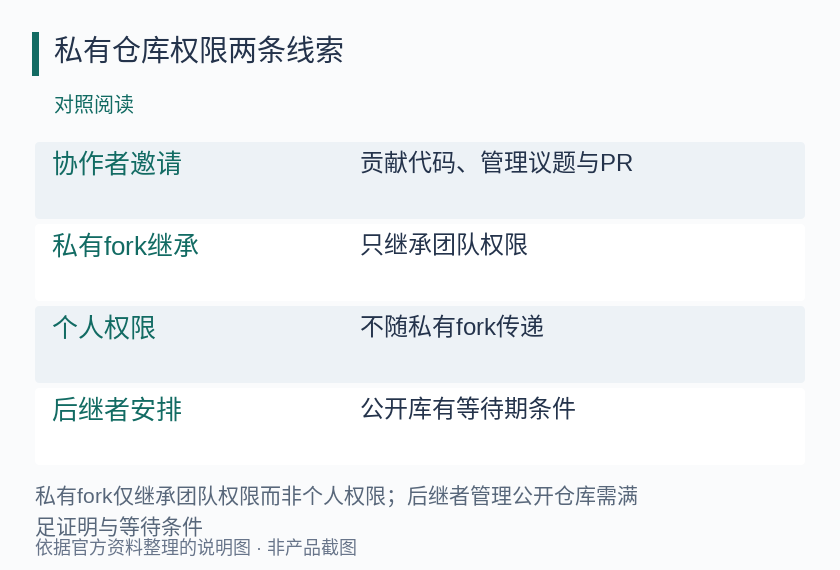
协作者机制解决的是“点对点”的授权问题。所有者邀请某个GitHub用户后,该用户便以协作者身份进入仓库,能够提交代码、处理议题和拉取请求。这种授权方式直接、灵活,适合小型团队或临时协作场景。
私有仓库的fork行为则涉及权限结构的继承问题。官方说明指出,私有fork会继承上游仓库的权限结构,这有助于私有仓库所有者维持对代码的控制。具体而言,如果上游私有仓库向某个团队授予了读写权限,那么该团队对上游仓库的所有fork也拥有相同的读写权限。但这里有一个关键边界:私有fork只继承团队权限,不继承个人权限。也就是说,通过协作者机制单独授予某个用户的个人权限,不会随fork向下传递。这一区分对依赖fork开展协作的团队尤为重要。
除了日常协作,GitHub还就用户拥有的仓库给出了后继者安排的建议。官方建议邀请另一位GitHub用户作为后继者,以便在本人无法管理时管理其用户拥有的仓库。就已列明的事实看,被指定的后继者在提交死亡证明并等待7天、或提交讣告并等待21天后,可以管理公开仓库。这一机制针对的是账户层面的延续性安排,与协作者的日常代码协作属于不同层面的权限设计,二者不应混为一谈。
综合来看,GitHub私有仓库的访问权限围绕协作者邀请和团队权限继承两条线索展开。协作者机制提供了直接的协作入口,私有fork的继承规则则划定了权限扩散的边界,而后继者安排处理的是所有者缺位后的管理延续。对于使用私有仓库的团队而言,厘清个人权限与团队权限在fork场景下的不同表现,是避免权限外溢、保持代码控制力的务实前提。
官方原文:[E1] 仓库所有者可通过邀请他人为协作者来协作,协作者可贡献代码并管理议题和拉取请求。 [E2] 私有fork继承上游仓库的权限结构,且仅团队权限(非个人权限)会被私有fork继承。 [E3] 官方建议邀请另一GitHub用户作为后继者,以便在本人无法管理时管理其用户拥有的仓库。 [E4] 被指定的后继者提交死亡证明后等待7天、或提交讣告后等待21天,可管理公开仓库。
[E1] https://docs.github.com/en/repositories/creating-and-managing-repositories/access-to-repositories (lines 7–7) You can collaborate with others on repositories you own by inviting them as collaborators. Collaborators have access to contribute to your code and manage issues and pull requests.
[E2] https://docs.github.com/en/repositories/creating-and-managing-repositories/access-to-repositories (lines 11–11) Private forks inherit the permissions structure of the upstream repository. This helps owners of private repositories maintain control over their code. For example, if the upstream repository is private and gives read/write access to a team, then the same team will have read/write access to any forks of the private upstream repository. Only team permissions (not individual permissions) are inherited by private forks.
[E3] https://docs.github.com/en/repositories/creating-and-managing-repositories/access-to-repositories (lines 17–17) We recommend inviting another GitHub user to be your successor, to manage your user owned repositories if you cannot. As a successor, they will have permission to:
[E4] https://docs.github.com/en/repositories/creating-and-managing-repositories/access-to-repositories (lines 22–22) An appointed successor can manage your public repositories after presenting a death certificate then waiting for 7 days or presenting an obituary then waiting for 21 days. For more information, see
原始资料
https://docs.github.com/en/repositories/creating-and-managing-repositories/access-to-repositories
声明:本站所有文章资源内容,如无特殊说明或标注,均为采集网络资源。如若本站内容侵犯了原著者的合法权益,可联系本站删除。